

No More Rewriting the Same Logic for Every Database
First, let me ask you: how many databases does your team use?
MySQL for OLTP, PostgreSQL for OLAP, Snowflake for the data warehouse, and occasionally, running a report on some legacy Oracle system – that’s practically standard for every data team today.
Now comes the question: How many times do you need to implement the same business logic?
The “dialect tax” every database imposes
SQL has a subtle concept called “dialect.” Standard SQL is one thing, but every database has its own “accent”:
MySQL has LIMIT. Oracle has ROWNUM. SQL Server has TOP.
Date functions: MySQL has DATE_ADD. PostgreSQL has INTERVAL. Oracle has ADD_MONTHS.
String concatenation: MySQL has CONCAT. SQL Server has +. PostgreSQL has ||.
Window function support, recursive CTE syntax, and GROUP BY strictness — every database has its own way of doing things.
You spend a whole afternoon getting a complex analytical SQL query working on MySQL. It runs beautifully. Then comes the requirement: run the same logic on Snowflake. You open the editor, copy the SQL over, hit run — and it throws an error.
Not because the logic is wrong, but because you are using the wrong dialect.
So, you start fixing it: replace LIMIT with QUALIFY, rewrite every date function, change the string concatenation syntax… Eventually, it works. But what happens when the requirements change again? Rewrite everything all over again? And what if the next project uses a different database?
You spend more time translating between dialects than thinking through the logic.
This isn’t an isolated case. According to a Stack Overflow survey, developers spend a significant amount of their coding time dealing with environment setup and compatibility issues. And SQL dialect differences are one of the most subtle yet costly forms of “compatibility tax”.
Worse still, the cost compounds. Every new database you support means one more SQL code version to maintain. Three databases = three SQL code versions. The change of one business rule means three places to update. Miss one update = production data don’t match = a midnight page to fix bugs.
Why can’t we “write once, run everywhere”?
You might think: “Then why not just use standard SQL?”
In theory, yes. But in practice, standard SQL cannot cover real-world business requirements. Dialect differences in window function support, the many different approaches to date and time handling, and different implementations of string operations – these are either undefined or loosely defined in the standard SQL, leaving each database with its own implementation.
Think about it differently: you don’t need “one SQL running everywhere”; you need “one logic generating SQL everywhere.”
These are two very different concepts.
“One SQL running everywhere” means sending the same SQL text to every database – and this approach simply doesn’t work.
“One logic generating SQL for every database” means writing the logic once and letting a tool compile it into each database’s dialect – and this is a path that works.
SQLazy’s approach: Write logic once, adapt to every dialect automatically
SQLazy takes exactly the second approach.
You express your logic as a workflow – a readable, step-by-step sequence of operations. The compiler then translates it into native SQL for the target database.
For example, the logic of “calculating the longest streak of consecutive up days of a stock” can be expressed as the following workflow:
Name |
Anchor |
Statement |
t1 |
stock |
filter CODE = 100046 |
t2 |
sort DT asc |
|
t3 |
segment CL down as NoRisingDays |
|
t4 |
summarize DT count as ContinuousDays group NoRisingDays |
|
t5 |
summarize ContinuousDays max as max_ContinuousDays |
This workflow is database-independent. It describes the logic, not SQL syntax.
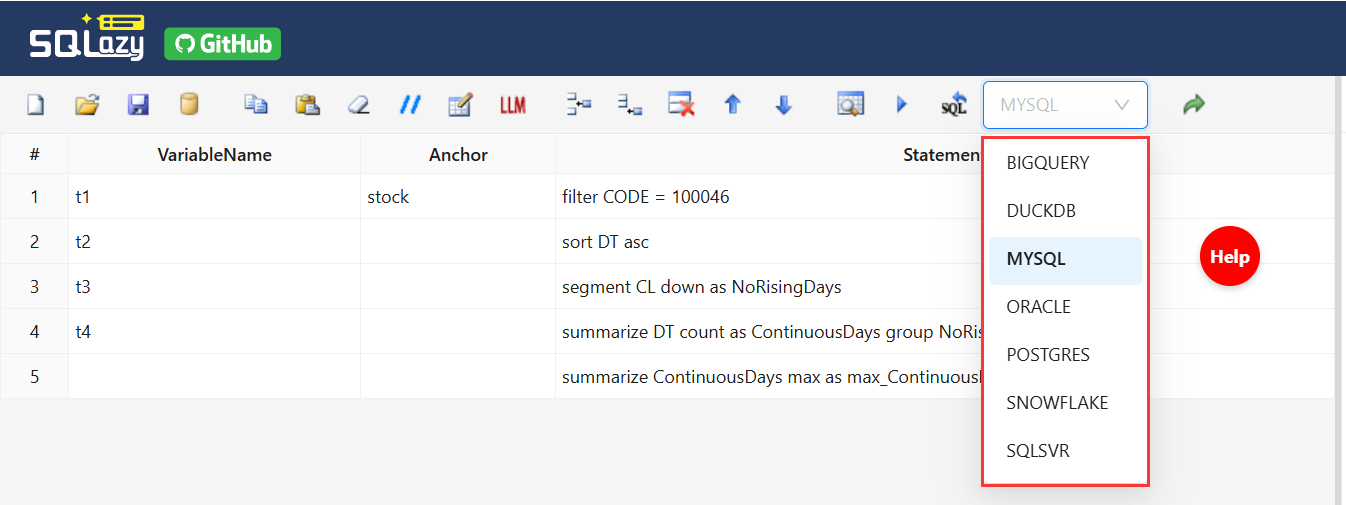
Then you tell the compiler the target database – MySQL, PostgreSQL, Oracle, Snowflake, or BigQuery, and it automatically generates native SQL for that database.
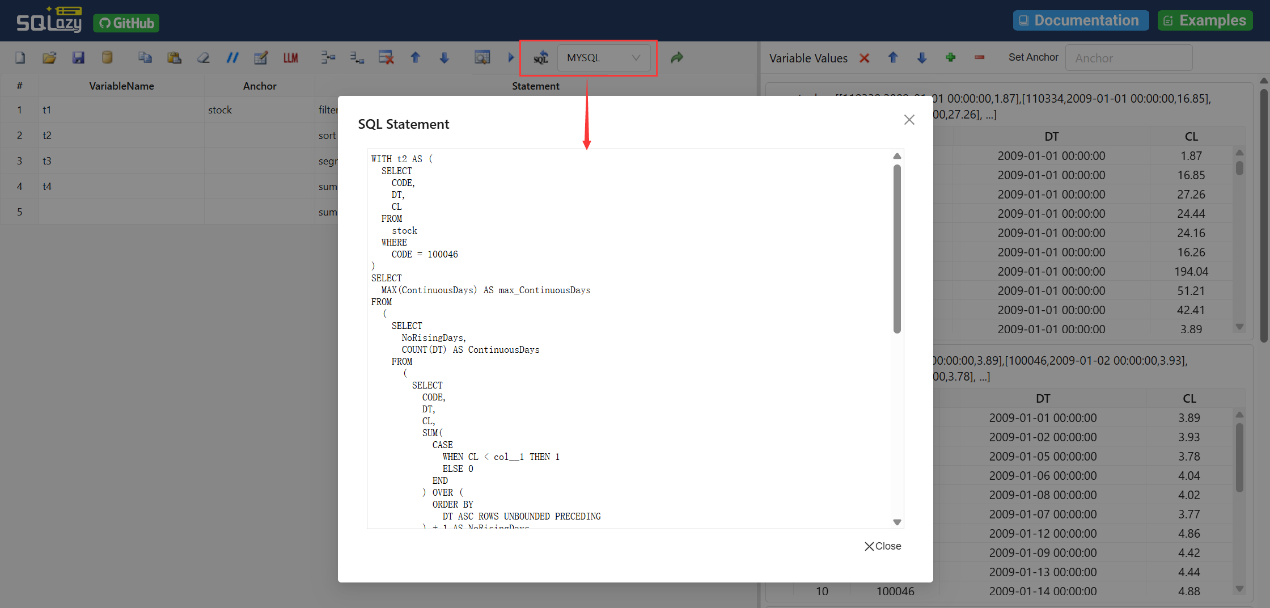
With the same workflow, simply switch the database option to generate SQL in a different dialect. You don’t need to rewrite anything.
Target database |
Differences of generated SQL |
MySQL |
Standard LIMIT, DATE_ADD |
PostgreSQL |
INTERVAL, || for concatenation |
Oracle |
ROWNUM, ADD_MONTHS |
Snowflake |
QUALIFY, IFF function |
The workflow stays the same because the logic stays the same. What changes is only the “accent” output by the compiler.
What does this mean?
First, you only need to maintain one version of the logic. When business requirements change, only update the workflow. The compiler regenerates native SQL for every database – no more “updating MySQL but forgetting Oracle”.
Second, it’s easier for new developers to get started. They don’t need to learn database dialect differences – they only need to understand the workflow, while the compiler handles the dialect translation. The workflow is for humans to read; SQL is for databases to execute.
Third, migration costs are nearly zero. Moving from MySQL to PostgreSQL? Just switch the database option, recompile, and the compiler automatically adapts to every SQL dialect. No need to modify code line by line, and no more dialect pitfalls.
Fourth, auditing becomes simpler. You audit the workflow – a readable representation of the logic, instead of hundreds of lines of SQL code versions scattered across different databases.
SQL dialect differences are not a minor inconvenience. They are the hidden tax data teams pay every day. Every additional database means more maintenance costs and a higher risk of errors.
SQLazy’s solution is simple: let compilers, instead of humans, translate dialects.
Your job is to write clear logic, and leave the rest to the compiler. You can also use an LLM to help write the logic. Natural language descriptions can then be standardized into SQLazy statements.
AI writes the logic. A compiler writes the SQL.
SPL Official Website 👉 https://www.esproc.com
SPL Feedback and Help 👉 https://www.reddit.com/r/esProcSPL
SPL Learning Material 👉 https://c.esproc.com
SPL Source Code and Package 👉 https://github.com/SPLWare/esProc
Discord 👉 https://discord.gg/sxd59A8F2W
Youtube 👉 https://www.youtube.com/@esProc_SPL


Chinese version